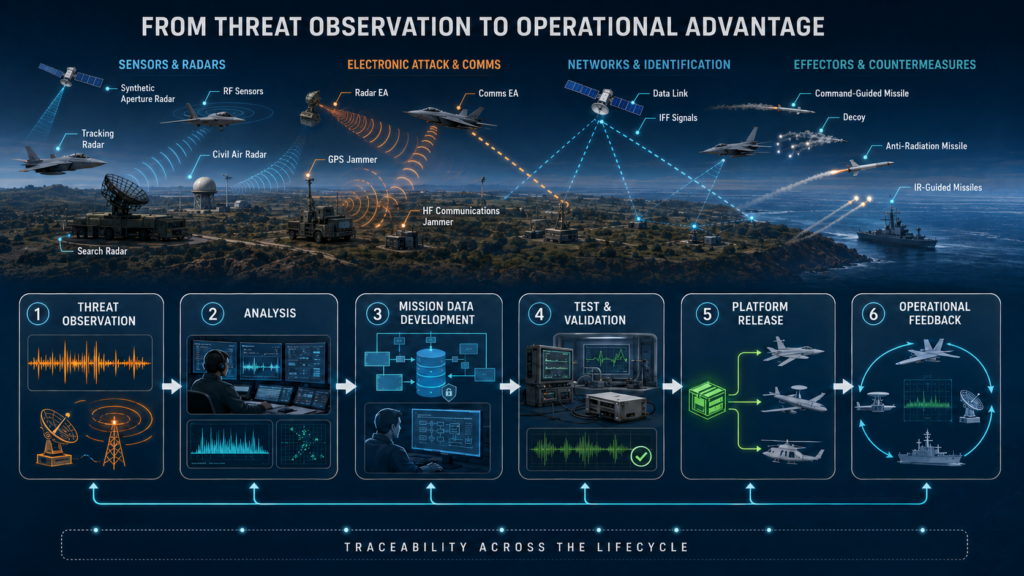






In electronic warfare, the decisive advantage is not simply collecting more information. It is preserving decision-quality technical context as evolving threat knowledge moves across the organizations responsible for turning it into trusted, field-ready mission data.
The Mission Data Imperative
The electromagnetic spectrum is increasingly crowded, contested, and dynamic. New emitters appear, known systems change operating modes, and adversaries adapt their tactics to complicate detection and response. In this environment, an electronic warfare system is only as effective as its ability to interpret what it encounters and apply the right response.
That is the role of EW Mission Data. Mission data provides the platform-specific information and logic that help onboard systems recognize, identify, prioritize, display, and—where appropriate—counter activity in the spectrum. It translates intelligence about an emitter into information a weapon system and its operators can use.
Threat knowledge does not arrive as a finished operational product. It must be assessed, translated into system-compatible data, tested, approved, distributed, and refined through feedback. The hardest problem is often not completing any one task; it is preserving enough technical context for the next organization to act.
Mission Data is not merely a file loaded onto a platform. It is the operational expression of intelligence, engineering judgment, system knowledge, test evidence, and decisions preserved across the lifecycle.
From Threat Discovery to Fielded Response
EW Mission Data is best understood as a lifecycle rather than a one-time production activity. The work begins with a change in the threat environment and continues until updated data is operating effectively on the platform. Strong mission outcomes depend on continuity across four connected functions.
- Establishing Technical Understanding
Before a system can respond appropriately, teams must understand the signal and its operational context. Analysts evaluate available intelligence, parametric data, observed behavior, associations, and confidence levels. The objective is not simply to catalog an emitter, but to determine which characteristics matter to the receiving system and the mission it supports.
This step requires disciplined analysis because incomplete or conflicting information is commonplace. Engineers and analysts must distinguish meaningful changes from noise, identify knowledge gaps, document assumptions, and determine whether an update is urgent, routine, or not yet sufficiently supported.
- Translating Knowledge Into Platform-Relevant Data
Threat information then must be converted into the formats, parameters, identification logic, priorities, and behaviors used by a specific system. That translation is rarely one-size-fits-all. Different platforms observe the spectrum through different sensors, process data through different software architectures, and support different operational missions.
Effective reprogramming therefore requires detailed knowledge of both the threat and the platform. The same intelligence may lead to different implementation decisions across a fighter aircraft, a command-and-control platform, an expendable, or another EW-enabled system. Mission relevance comes from making those decisions deliberately—not from moving data mechanically between databases.
- Testing for Technical and Operational Confidence
Speed matters, but unverified speed can create risk. Updated mission data must be evaluated to confirm that it performs as intended, does not introduce unintended effects, and remains compatible with the system’s software and operational configuration. Depending on the need and available infrastructure, verification can include data reviews, software-based analysis, modeling and simulation, laboratory integration, hardware-in-the-loop activity, and open-air or operational testing.
No single test method answers every question. Modeling and simulation can expand scenario coverage and accelerate early assessment. Laboratory environments provide repeatability and controlled conditions. Live testing contributes physical realism and exposes interactions that may not be fully represented elsewhere. The strongest approach uses these methods as complementary layers of evidence, scaled to the urgency and consequence of the change.
- Fielding, Feedback, and Continuous Improvement
A validated update creates value only when it reaches the intended users in time and in a configuration they can employ. Distribution, version control, platform compatibility, technical orders, mission planning interfaces, and operator awareness all influence the final outcome. In distributed or contingency operations, communications and access constraints can make this last mile especially challenging.
The lifecycle does not end at fielding. Operational observations, maintenance findings, test results, and newly available intelligence should flow back into the next assessment. That feedback closes the loop between laboratory assumptions and real-world performance, enabling mission data to evolve with the environment it is designed to address.
A Mission Data Challenge in Practice
Consider a known emitter whose operating behavior changes. Available intelligence is incomplete, multiple platforms may be affected, and representative test resources are limited. The challenge is not simply updating a record. Teams must determine which changes are operationally significant, identify affected platform and software baselines, develop candidate updates, assess unintended identification effects, select an appropriate test path, and document release limitations.
Each decision relies on information produced elsewhere. Analysts must communicate source context and confidence; engineers must document implementation logic; platform teams must identify configuration dependencies; and test and release authorities need expected behavior, acceptance criteria, evidence, and residual risk. Missing information can force repeated analysis, baseline reconciliation, or additional testing—delaying the operational response even when the technical change itself is sound.
Where Traditional Mission Data Processes Lose Time
Many mission data workflows were built for a more predictable pace of change. As operational timelines compress, four recurring sources of friction become more consequential.
Incomplete handoffs: Work pauses when the receiving team lacks source confidence, platform applicability, configuration information, test evidence, approval status, or release limitations.
Platform-specific tools and formats: Specialized environments protect platform fidelity, but may limit data reuse and cause similar preparation and validation work to be repeated across systems.
Manual workflows and key-person dependencies: Time spent reconciling versions, rebuilding inputs, and reconstructing earlier decisions consumes scarce expertise and slows urgent work.
Late validation and weak feedback loops: Limited laboratories, threat simulators, platform hardware, and ranges make late discovery expensive, while poorly captured field observations prevent lessons from improving the next release.
Speed and Confidence Are Not Opposing Goals
Calls for rapid reprogramming are sometimes treated as pressure to bypass rigor. The more useful objective is to remove avoidable delay while preserving the technical evidence needed for a responsible release. That means improving the workflow around expert judgment rather than compromising the judgment itself.
A more responsive mission data enterprise begins work in parallel where risk permits. Analysts, developers, testers, platform experts, configuration managers, and release authorities can collaborate earlier on data sufficiency, requirements, test design, evidence needs, and fielding constraints. Early integration exposes incompatibilities before they become schedule-driving failures. Reusable test assets, automated data checks, controlled baselines, and traceable decisions reduce repetitive effort while making the final product easier to review, approve, and maintain.
The appropriate level of testing also should be proportional to the change. A narrowly scoped correction does not always require the same path as a major update that alters identification or response behavior. Clearly defined risk categories and release criteria allow teams to move urgent changes faster without treating every modification as low risk.
The goal is not to choose between speed and rigor. It is to build a process in which rigor can be achieved faster.
The Human Role in a More Automated Enterprise
Targeted automation, data engineering, analytics, and digital test capabilities can improve mission data workflows, but their best use is to amplify expert performance. Automated checks can flag incomplete records, inconsistent parameters, version conflicts, and formatting errors. Analytics can help triage large signal sets and prioritize items for deeper review. Digital test environments can increase scenario coverage before scarce hardware or range time is used.
These capabilities are valuable precisely because they return time to the analysts, engineers, testers, and operators who must make difficult decisions. Algorithms do not independently determine whether intelligence is trustworthy, whether a modeled scenario adequately represents operational conditions, or whether a response is appropriate for a particular mission. Those judgments depend on experience, context, and accountability.
Human-centered modernization therefore should make assumptions visible, preserve traceability, and present information in a way that supports review. A fast workflow that obscures why a change was made is not resilient. A modern workflow should allow another qualified team member to understand the source, logic, test evidence, approvals, and limitations behind the released data.
What the Next Generation of EW Mission Data Requires
Future advantage will depend on treating Mission Data as an operational capability that must be designed for continuous change. Several principles will shape that evolution:
Interoperable data foundations: Common data models, well-governed interfaces, and machine-readable exchanges can reduce repeated translation while allowing platform-specific implementation to remain where it is technically necessary.
Integrated development and test: Linking analysis, mission data generation, simulation, laboratory testing, and configuration management creates earlier evidence and shortens the path to a trusted release.
Distributed collaboration: Secure, resilient workflows must support teams operating across organizations and locations, including conditions in which connectivity, classification boundaries, and access to specialized infrastructure constrain the ideal process.
Modular automation: Targeted tools should automate repeatable, high-volume tasks without creating a monolithic system that is difficult to adapt to changing platforms, threats, and missions.
Operationally meaningful measures: Success should be evaluated through outcomes such as time from new information to initial assessment, time from an approved requirement to a test-ready candidate, time spent waiting between organizations, baseline discrepancies discovered late, regression-test reuse, scenario coverage, defect escape rate, release traceability, and time to distribute an approved update—not simply the number of records processed or files produced.
A workforce built for the full lifecycle: The enterprise needs both deep specialists and professionals who understand how intelligence, EW engineering, software, test, platform behavior, configuration control, and operational employment connect. Integration across those specialties is what turns individual technical outputs into mission effect.
The DCS Difference: Continuity Across the Mission Data Lifecycle
DCS strengthens government execution by providing specialized expertise, technical continuity, integration support, and disciplined engineering processes while preserving government decision authority. With more than a decade supporting EW and mission data organizations, DCS personnel understand how work moves across intelligence, engineering, software, test, program, configuration, and operational interfaces—and what each organization needs before it can act.
That experience spans the acquisition and sustainment lifecycle, including early acquisition activities, including support to analyses of alternatives and pre-Milestone B engineering, developmental and operational test, and sustainment support. DCS personnel have supported hardware-in-the-loop laboratories, flight tests, and operational environments across all Combat Air Forces aircraft. This breadth helps teams anticipate how an implementation decision affects platform baselines, regression testing, approval evidence, distribution, and operational use.
DCS personnel help maintain continuity across these interfaces by reconciling intelligence and engineering inputs, preparing platform-specific data, supporting test planning and discrepancy resolution, and documenting decisions and release limitations. Relevant lessons and proven methods can be shared across platform teams where security, data rights, and technical applicability permit, helping customers avoid unnecessary duplication without forcing different systems into a common workflow. Cross-platform sharing can reduce redundant analysis and test preparation when requirements, data, or methods are genuinely reusable.
DCS begins with the customer’s mission environment: government-furnished tools, established baselines, local configuration-management practices, security constraints, and platform-specific authorities. Targeted automation and process improvements are introduced where they produce measurable value and remain supportable by the government. The result is stronger execution within the existing mission data enterprise—not dependence on a contractor-owned process.
The Bottom Line
In electronic warfare, yesterday’s understanding can quickly become today’s vulnerability. Operational advantage depends on mission data that reflects the best available intelligence, is engineered for the specific system, is tested to an appropriate level of confidence, and reaches the platform when needed.
EW Mission Data is where intelligence becomes executable understanding. DCS helps government teams move that understanding through the full lifecycle by combining platform-specific depth with experience across analysis, development, test, sustainment, and operational environments. That combination helps turn emerging threat knowledge into technically credible, fielded capability without sacrificing government ownership or mission judgment.